
Your Carpet Cleaning, Stretching & Repair Questions — Answered
From carpet wrinkles and permanent patches to pet urine, cleaning methods, room measurements and upholstery protection, this FAQ brings together the questions customers ask Indy All Pros in Indianapolis and surrounding Central Indiana.
Questions About Your Carpet or Home?
The original Indy All Pros FAQ covers common problems customers ask about before booking: damaged edges, wrinkles, carpet repair, pet stains and odors, furniture movement, job duration, power stretching, pricing, cleaning methods, urine treatment, cleaning frequency, carpet protection, room measurements and sectional furniture.
For a situation that is unusual or difficult to describe, David can discuss the project directly by phone or text at 317-889-0692.
Frequently Asked Questions
1. Can you fix carpet that has been damaged by a vacuum or a transition strip?
Yes. If your vacuum “ate” the edge of your carpet or it is pulling away from hardwood or tile, Indy All Pros can address the transition. New tack strips or transition bars may be installed when needed. The goal is to secure the carpet and help prevent further fraying.
2. Why is my carpet wrinkling or bunching up?
Carpet ripples and waves can happen because of improper initial installation, high humidity—common during Indiana summers—or heavy foot traffic and moving heavier objects over the carpet.
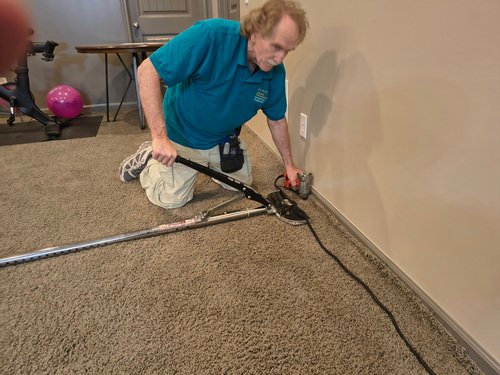
If carpet was not properly power-stretched during installation, it can eventually lose tension. Indy All Pros uses professional power stretchers rather than simply kicking the carpet into place, pulling the carpet tight across the room.
3. Is it worth repairing my carpet, or should I just replace it?
Many homeowners assume a permanent stain or burn means the carpet must be replaced. Indy All Pros explains that a permanent section or patch may be possible in many situations. A small piece of matching carpet from a closet or remnant can sometimes be installed into the damaged area.
This can cost substantially less than replacing an entire room and may extend the useful life of the existing carpet. The actual repairability depends on the damage and available matching material.
4. Can you really get pet stains and odors out of old carpet?
Pet accidents can affect more than the carpet surface. Liquid may reach the padding and subfloor. Indy All Pros uses professional-grade enzymes and neutralizers intended to break down organic material rather than simply masking the smell.
When contamination is severe, replacing the pad may be necessary because the padding can hold the odor source.
5. Do I need to move all my furniture before you arrive?
For a standard carpet-stretching job, the large items in the center of the room generally need to be moved. Heavy pieces such as entertainment centers or dressers may sometimes be worked around using specialized tools.
When you request an estimate, discuss your specific room layout so the preparation requirements are clear before the job.
6. How long does a typical carpet repair or stretching job take?
Most carpet repair and stretching jobs in the Indianapolis area are described on the original FAQ as taking approximately 1 to 3 hours, depending on the project.
7. What is the difference between “Knee Kicking” and “Power Stretching”?
A knee kicker is a small tool useful for tight corners, but it does not provide the same reach and tension as equipment designed to stretch an entire room.
Power stretching uses a long-pole tool braced against the opposite wall to apply strong, even tension across the carpet. Indy All Pros uses professional power-stretching equipment for wall-to-wall stretching.
8. How much does carpet stretching cost in Indianapolis?
Every home and room is different. The original FAQ states that Indy All Pros provides free, honest estimates and does not use hidden fees. For a stretching quote, room dimensions and the specific condition of the carpet are useful information.
What Is the Best Carpet Cleaning Method?
The original FAQ compares dry cleaning, shampooing and several steam-cleaning approaches. It emphasizes the importance of loosening soil and stains before extraction rather than simply putting cleaning material onto the carpet and leaving residue behind.
Dry Cleaning
Dry cleaning can involve applying a dry chemical, working it into the carpet and vacuuming it out. Another technique uses white round pads heated in a water bath. The original FAQ emphasizes thorough vacuuming before and after the process and raises the question of how deeply soil is extracted from the fibre.
Shampooing
Shampooing is described as the original carpet-cleaning approach. The FAQ’s concern is whether the process fully extracts the dirt from the carpet fibre.
Steam Cleaning
The FAQ discusses steam cleaning without pre-spray, steam cleaning with detergent, and the importance of pre-treatment, agitation and rinsing/extraction. It compares carpet cleaning to washing clothes: chemical treatment, agitation, hot water and removal of the dirty water all matter.
Customers are encouraged to vacuum thoroughly before arrival. The appropriate pre-spray is selected according to the condition of the carpet. The original FAQ describes odor treatment, degreaser, protein-stain remover and brightener as possible components. For urine-affected carpet, the treatment approach changes to acid cleaners and specialized urine treatment.
After pre-spray, the carpet is agitated with a floor machine. The brush selection depends on the carpet and soil being treated. The solution vacuum is then brought to the furthest starting point, with the operator working back toward the starting position and going over cleaned sections again to help improve dry time.
How Do I Remove Pet Urine From Carpets?
What happens to urine in carpet?
The original FAQ explains that urine can turn into salt particles in carpet or flooring and must be treated according to the affected source. White vinegar may sometimes affect salts, but the FAQ states that more treatment is generally needed.
What is the Indy All Pros urine-treatment process?
The original process is described as: first heavily pre-spray with a urine treatment; second, agitate with a deep scrub to work the chemical into the fibre and break up urine salts; third, rinse everything through a deep steam clean using an odor counteractant.
The FAQ also notes that additional disinfection may sometimes be necessary. It specifically warns that using regular carpet-cleaning chemicals over a urine problem can make the odor worse.
When is carpet too badly affected to save?
The FAQ says that dark yellow staining with several affected areas can indicate that the carpet may not be salvageable and that the flooring may need treatment before new flooring is installed. It suggests checking beneath a corner of the carpet for yellow spots on the backing when the severity is uncertain.
Can the carpet pad need to be replaced?
Yes. The FAQ explains that urine odor and salts can settle primarily in the pad and floor. If the customer plans to keep the carpet, replacing contaminated padding may be recommended. Indy All Pros also performs pad replacement.
How Often Should I Have My Carpets Cleaned?
The original FAQ points out that carpets can become dirty from sources that are not immediately obvious. Heating and air-conditioning systems can contribute to dry soil, so keeping HVAC filters clean is recommended.
Dry soil can settle into carpet and eventually stain fibres. Bare feet can transfer body oils, while dogs can add oils and dirt from their paws and skin. Traffic patterns and the places where pets lie down can reveal where soil is accumulating. The FAQ recommends frequent vacuuming—at least twice a week and potentially every other day depending on conditions—and changing clothes after coming home from work can also reduce the transfer of outside soil.
The direct answer in the original FAQ is to have carpet professionally cleaned when vacuuming no longer improves its appearance, or when it remains dirty or begins to smell in the home or room.
Why Do I Need Protection on My Carpets?
Should carpet protection be applied after cleaning?
The original FAQ says carpet or upholstery protection should be applied after cleaning when appropriate. It specifically discusses fibre type: Nylon is identified as a carpet where protection may be useful, while Berber, polyester and polypropylene are described in the original FAQ as not needing Gard because it will vacuum off.
What about upholstery protection?
The original FAQ recommends considering upholstery protection every time because upholstered furniture cannot simply be put into a washing machine and the fibre can be as thin as clothing.
What Is Considered a Room?
According to the original FAQ, bedrooms can be approximately 120–150 square feet, while many newer-home bedrooms can be around 12 × 15 feet. A master bedroom can be approximately 200 square feet, with a walk-in closet potentially making the total count two areas.
A living room, loft or family room can range from approximately 150 to 400 square feet depending on the home. The practical question is whether the home or apartment is average-sized or large when considering an area count.
How Can I Measure a Room for Stretching or Carpet Cleaning?
The original FAQ gives a simple method: place one foot in front of the other, toe to toe, to estimate the room size, or use a measuring tape. Measure the length and width. Irregular rooms may need to be squared off for a more accurate area.
For example, a 12 × 16 foot room is 192 square feet.
| Example | Measurement | Approximate Area |
|---|---|---|
| Bedroom | 12 × 15 ft | 180 sq ft |
| Example room | 12 × 16 ft | 192 sq ft |
| Master bedroom + walk-in closet | Varies | May count as 2 areas |
How Many Pieces of Furniture Is My Sectional?
The original FAQ provides a rule of thumb for counting sectional furniture:
- 2 cushions = a loveseat
- 3 cushions = a sofa
- 1 cushion = a chair
- A chaise = approximately 5 to 6 feet long
- A corner piece = approximately the same as a loveseat
For example, a sectional with a sofa, corner piece, loveseat and chaise would be counted as 4 pieces.
Talk Directly With Indy All Pros
The FAQ can help with common questions, but carpet condition, room layout, pet contamination and repair needs can vary. David can discuss your specific situation and help determine what information is needed for an estimate.
Get Your Carpet Questions Answered
Cleaning, wrinkles, repairs, pet odors, measurements or upholstery—tell us what you are dealing with.